· Updated
Sports massage & recovery in the Lisbon area
Benefits and limits of sports massage, pre- vs post-training timing, hydration and sleep, contraindications, when to see a physiotherapist, common mistakes, and pairing with urban running and cycling.
sportrecoveryLisbonmassagerunning
Greater Lisbon gathers runners, cyclists, crossfit regulars, and many people who simply want to move outdoors. Sports-oriented massage can support recovery and routine — as long as you respect its limits: it does not replace rehabilitation or justify ignoring injury signals.
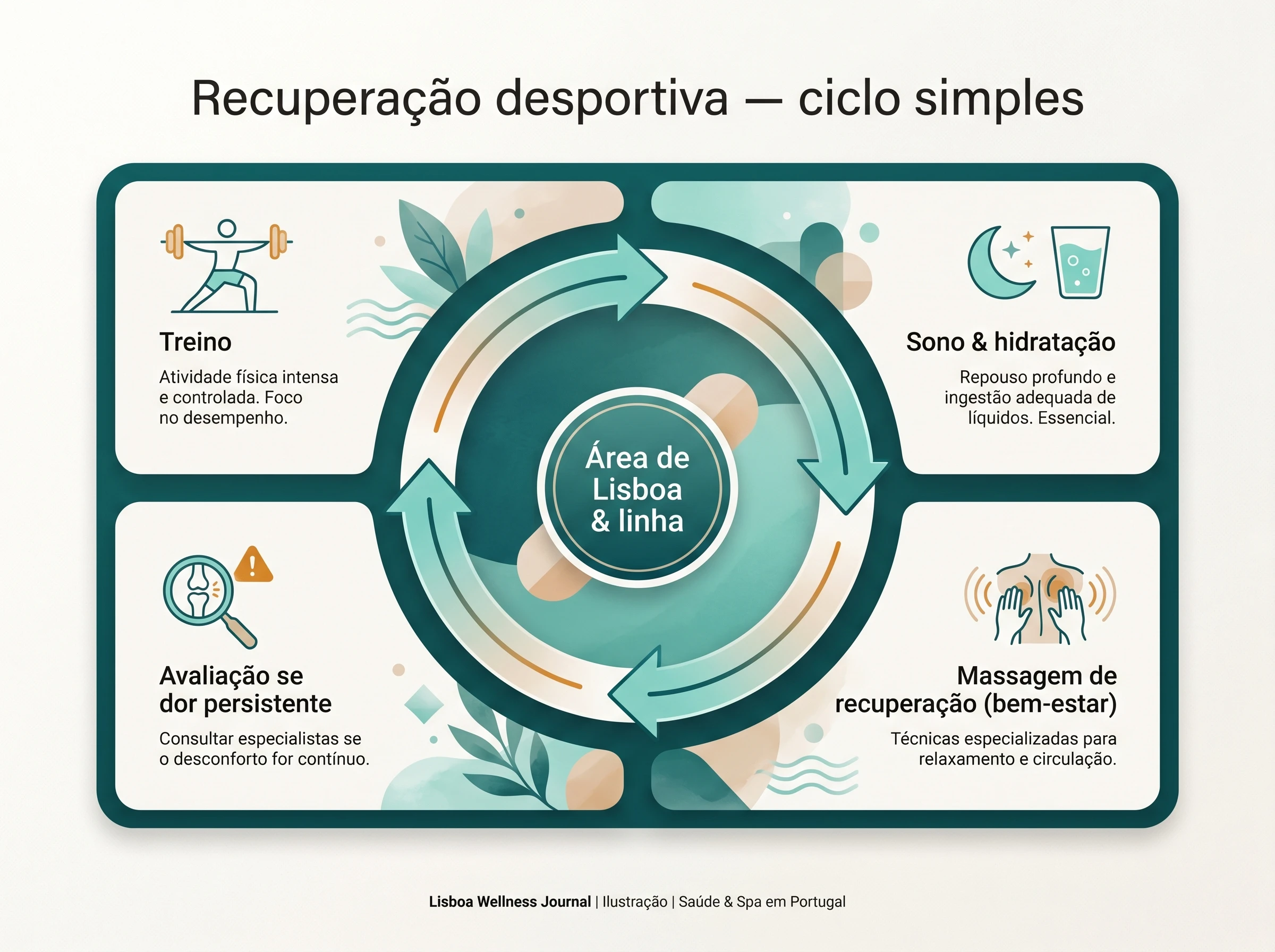
Editorial infographic
Conceptual flow — editorial illustration.
Commercially, the label usually covers:
- faster, segmented work on loaded muscle groups;
- kneading, compression, light assisted stretching;
- focus on legs, lower back, upper back, and sometimes shoulders (cycling).
It is not the same as deep clinical work for acute injury.
- Comfort and perceived relief after overload.
- Routine touch that helps you notice tension early.
- Subjective wellbeing and training continuity with less discomfort.
(Research is heterogeneous — treat absolute claims cautiously.)
Do not rely on massage when there is:
- acute pain with functional limitation;
- sudden knee or ankle swelling;
- fever;
- skin infection or open wound;
- oncology or thrombosis history without medical clearance.
Under-18 athletes with injury: clinical assessment first.
| Timing | Typical aim | Notes |
|---|---|---|
| Pre | “Wake up” tissues, subjective mobility | Brisk pace; avoid pain |
| Post | Calm the system, comfort | Slower pace; hydrate |
After a long event, many athletes wait 24–48h before very deep work — individual variation applies.
Massage does not compensate for:
- chronic 4–5h sleep;
- dehydration (especially after alcohol);
- training volume far above recovery capacity.
Simple rule: if training ramps faster than sleep, massage alone will not hold the structure up.
- Pain not improving over 1–2 weeks despite relative rest.
- Radiation to arm or leg, numbness, or weakness.
- Joint instability or locking.
- Post-surgical rehab or tendinopathy protocols.
- Passive rest only — no mobility or strength work.
- Ignoring cobbles and worn trainers when running.
- Aggressive urban cycling posture without bike fit.
- Comparing to influencers — training load is individual.
- Running: communicate weekly kilometres and surface (asphalt vs trail).
- Cycling: wrists, neck, and posterior chain matter as much as quads.
For massage types outside sport, see how to choose.
- Road trip & nature — recovery after hiking.
- West coast — surf and wellbeing.
Use sports-style massage as a routine tool and body awareness aid, not a miracle promise. If clinical doubt appears, the path is healthcare — not the spa room.
General information. For injuries or severe symptoms, see healthcare professionals.
Frequently asked questions
Your body clears metabolites through several systems. Massage may feel relieving, but oversimplified ‘toxin’ stories are not rigorous. What matters is whether you feel better and have no alarm symptoms.