· Updated
Types of massage: how to choose (relaxation, therapeutic, sports)
Swedish, relaxation, sports, deep tissue, manual lymphatic drainage — general indications, contraindications, questions to ask, session length, and how wellness massage differs from physiotherapy in Portugal.
massageguidehealthLisbonphysiotherapy

Choosing a massage starts with one question: what do I want to feel when I leave the room? The market uses dozens of commercial names; below is a practical map of common modalities, general indications (not medical advice), and safety criteria.
Editorial infographic
Conceptual overview — editorial illustration.
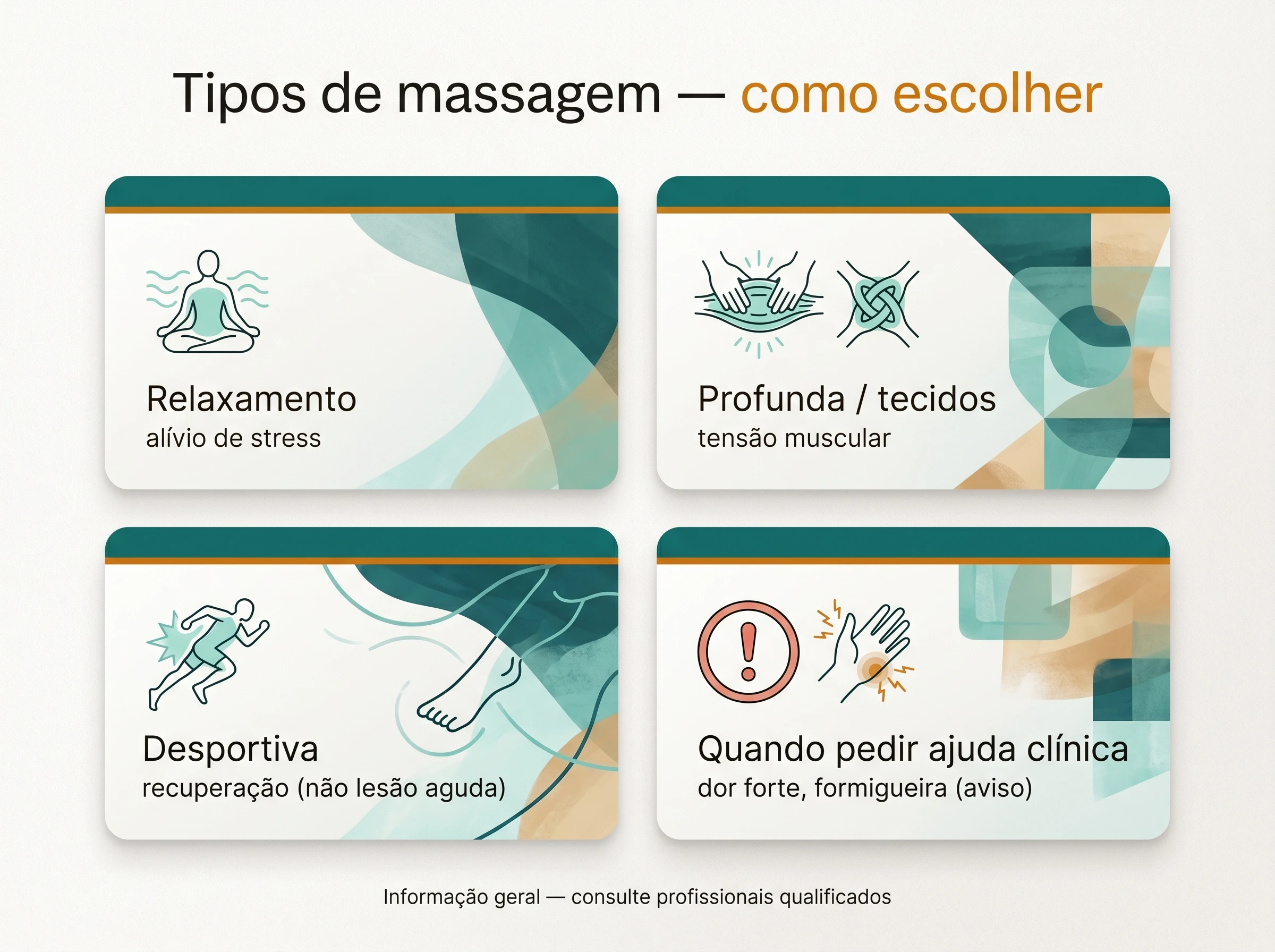
Goal: nervous-system downshift, self-care routine, mild everyday tension relief.
Feel: moderate pressure, steady rhythm, little pain.
Who for: work stress, first massage, post-flight decompression.
Goal: work superficial to mid muscle with traditional strokes (gliding, kneading, light vibration).
Feel: relaxation with more variety than a generic “relaxation” label.
Who for: full-body experience without a clinical focus.
Goal: support warm-up or recovery from effort — not treat acute injury.
Feel: faster pace, more focus on loaded muscle groups.
Who for: running, cycling, regular strength training.
See also: sports massage around Lisbon.
Goal: reach deeper muscle and fascia layers for persistent tightness.
Feel: sustained pressure, local discomfort possible — it must be adjustable with the therapist.
Who for: chronic mild stiffness (without medical red flags).
Goal: very gentle, repetitive rhythm, sensation of lightness.
Feel: almost painless; patience is part of the method.
Who for: cosmetic comfort or mild “heavy legs” sensation.
Alert: sudden swelling, one-sided swelling, or chest pain = medical emergency, not massage.
Go deeper: Lymphatic drainage: benefits and techniques.
- Fever, acute infections, acute inflammatory flares.
- Open wounds, burns, skin infections.
- Thrombosis history or recent thrombotic events (without medical clearance).
- Some oncology or cardiac contexts — only with professional guidance.
- Pregnancy: specific protocols.
The therapist should take a history — if they ask nothing, be cautious.
- Training and experience with the advertised style.
- Oils — ingredients; hypoallergenic options.
- Can I reduce pressure mid-session? (the answer should be yes).
- Focused area or always full body?
- Policies for pregnancy, oncology, or recent pain.
- 60 minutes is often the minimum that makes sense for full body.
- 90 minutes allows deeper work or two areas with time.
- 30 minutes — useful for a focal area; do not expect deep release miracles.
| Aspect | Wellness massage | Physiotherapy |
|---|---|---|
| Main goal | Comfort, routine, mild tension | Rehabilitation, pain, dysfunction |
| Professional | Varies — demand transparency | Registered with Ordem dos Fisioterapeutas |
| Diagnosis | Not expected | Part of clinical process |
| Follow-up | Optional | Treatment plan |
If you need prescription, sick leave documentation, or post-surgical rehab, the route is healthcare — not the spa. For professional framing in Portugal, read Wellness vs. physiotherapy.
- Choosing only by marketing labels (“detox”, “ancient”) without knowing what is included.
- Confusing muscle ache with joint issues — persistence deserves assessment.
- Repeating deep tissue too often without recovery time.
- Poor sleep and hydration while expecting massage alone to fix everything.
Choose by goal, not by a fancy name. Communicate limits, adjust pressure, and keep expectations realistic — massage is a wellbeing tool, not a substitute for medicine.
General information. For worrying symptoms, contact healthcare professionals.
Frequently asked questions
Commercially, the terms often overlap. Classic Swedish work blends gliding, kneading, light friction, and gentle percussion to promote relaxation and circulation. ‘Relaxation’ is often a spa label for a full-body session at moderate pressure. What matters is agreeing on pressure and areas.